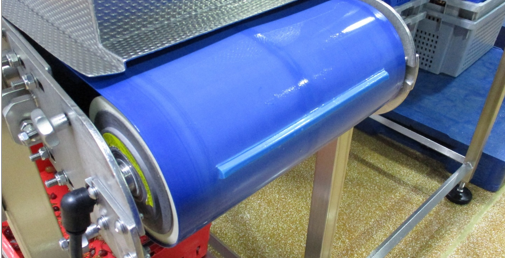
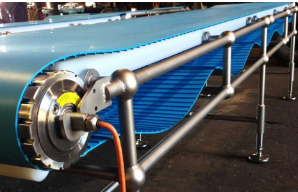
When it comes to sourcing replacement drum motors are you looking for a direct replacement to solve ongoing problems?
Do your existing units suffer from water ingress or frequent motor burnouts? Does the rubber laging wear quickly or conveyor belts not track centrally?
Come and talk to us in the first instance to discuss your problems and see what we can offer, even starting your product selection again from scratch on existing conveyors.
With special IP ratings to obtain optimal sealing, rubber lagging materials to extend service life and different shell and end cap materials we can help you solve any ongoing issues.
Some of the manufacturers we can supply:
Check our FAQs and see if your question has already been answered. Still not found what you’re looking for? Head over to our contact page.
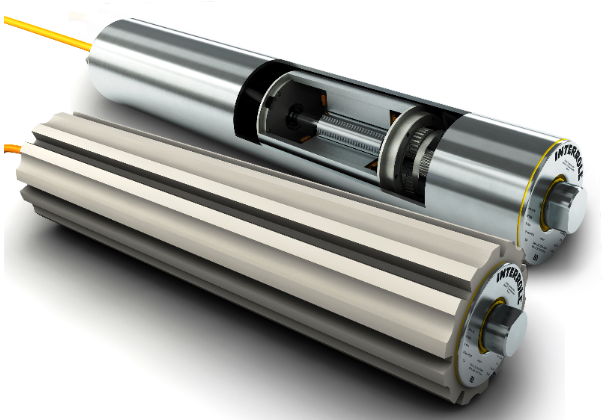
The cylindrical roller at each end of a conveyor. The drive drum transmits power to the belt, the tail drum guides and tensions it. A drum motor is a drive drum with the motor and gearbox built inside the shell.
A drum motor houses the motor and gearbox inside the conveyor drum itself. Everything is sealed within the roller, so there is no external motor, gearbox, chain or guard hanging off the side of the frame.
It depends on the environment. Drum motors suit hygiene and space constrained applications because they are sealed and compact. External geared motors suit heavy duty applications where high torque and easy access for maintenance matter more.
Broadly three: drum motors built into the roller, external geared motors driving through a coupling or chain, and shaft mounted gearboxes fitted directly to the drive shaft. Each suits a different combination of duty, space and access.
Fewer exposed moving parts, a smaller footprint, no chain or belt to tension, better hygiene for washdown areas and lower noise. On food and packaging lines those usually outweigh the higher unit cost.
Sizing works from belt width, belt speed, the load carried and the incline. Send those figures along with the conveyor frame dimensions and we will specify the diameter, speed and power.
Yes, using an inverter drive to control belt speed. Specify inverter duty at the point of ordering rather than adding a drive to a fixed speed unit later.
Very little, which is much of the appeal. There is no external chain or belt to adjust. Oil changes at the manufacturer's interval, plus periodic checks on the mounting and the electrical connection, are usually the extent of it.
Almost always a failed shaft seal, often because bearing wear has let the shaft move. Stop and repair rather than topping up, because once the oil level drops the internal gearing and bearings wear rapidly.
Rubber and other lagging can be bonded to the shell to improve belt grip and tracking, which matters on inclined conveyors or where wet or dusty material reduces friction.
Yes. Both workshops have extensive experience overhauling motorised drums, covering bearings, seals, internal gearing and rewinds. Repair is usually a fraction of the cost of a new drum.
Send the make, model and dimensions, or a photograph of the nameplate. We match shell diameter, face width, speed and power to a current equivalent, and can machine adaptors where the mounting differs.
A Division of:

Registered in England And Wales – 415925
Registered address: Harlaxton Road, Grantham, Lincolnshire, United Kingdom, NG31 7SF
Registered for VAT: 610 425 096
Copyright ©Grantham Engineering Ltd