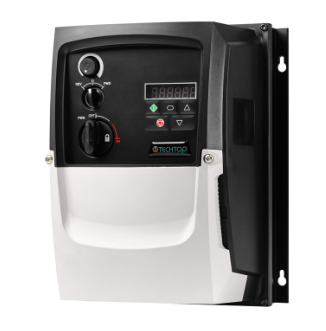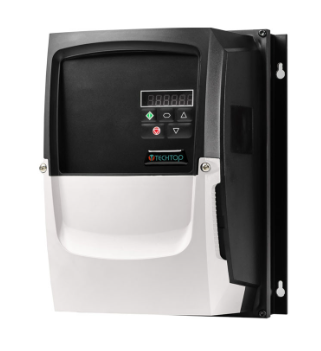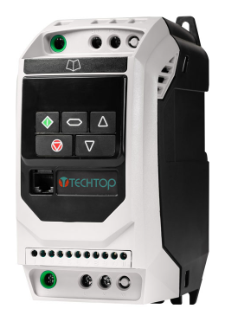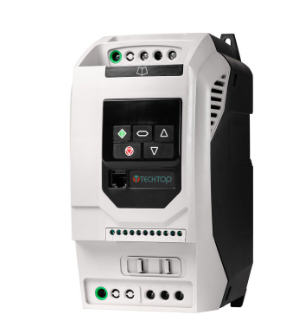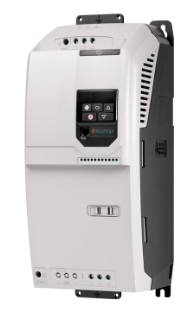
As the regions only TEC Platinum Distributor we are able to offer a full range of Techtop inverters to suit your requirements.
If you are unsure whether an inverter would be suitable please talk to us, we have technical experts on hand to be able to discuss your application or visit site to meet with you and discuss face to face.
A variety of different units are available from standard panel mounted IP20 units though to IP66 switched versions that can be fitted line side outdoors with the ability for lockable isolation, speed control and direction control all in one unit.
If energy saving is key to your business speak to us today about calculating how much money you could save by fitting inverter drives to pump and fan applications.
Check our FAQs and see if your question has already been answered. Still not found what you’re looking for? Head over to our contact page.
A drive that controls motor speed by varying the frequency and voltage supplied to it. Rather than running the motor flat out and throttling the output, the motor turns only as fast as the process actually needs.
It rectifies the incoming AC to DC, then switches that DC back into AC at whatever frequency you ask for. Motor speed follows supply frequency, so changing the frequency changes the speed.
Not always. Inverter switching stresses winding insulation, and a motor cooled by its own shaft fan loses cooling at low speed. Older motors in particular may not be rated for it. Check the specification first.
Standard three phase induction motors are the usual pairing, ideally ones stated as inverter duty. Permanent magnet and synchronous reluctance motors need a drive by design and reach higher efficiency classes.
Purchase cost, some heat loss in the drive itself, potential harmonics on the supply, and the risk of bearing currents on the motor if it is not installed and earthed properly. Correct installation removes most of that.
A motor built to run on an inverter, with insulation rated for the switching voltages and usually separate forced cooling so it can run slowly without overheating. It is not the same as a standard motor with a drive bolted on.
In practice the terms are used interchangeably. Variable speed drive is the broader description, while inverter or variable frequency drive refers specifically to controlling an AC motor by changing supply frequency.
The largest savings are on fans and pumps, because power falls sharply as speed reduces. A modest speed reduction on a fan or pump cuts energy use significantly, which is why payback on those applications is often short.
Size to the motor's full load current rather than just its kilowatt rating, and allow for the duty. Overload characteristics matter on applications with high starting torque. Tell us the motor and application and we will specify it.
Common causes are overload, a motor or cable insulation fault, over voltage on deceleration, overheating from a blocked heatsink, or parameters set wrongly for the load. The fault code on the drive usually narrows it quickly.
Keep them clean and cool. Dust on the heatsink and failing cooling fans are the usual causes of early failure, along with capacitor ageing on drives that sit unused for long periods.
Yes. Ramping the motor up rather than starting direct on line reduces mechanical shock on belts, couplings and gearboxes, and cuts the current peak on your supply.
A Division of:

Registered in England And Wales – 415925
Registered address: Harlaxton Road, Grantham, Lincolnshire, United Kingdom, NG31 7SF
Registered for VAT: 610 425 096
Copyright ©Grantham Engineering Ltd